Friday, 31 May 2024

Unusual Times! Will current technology need to be reimagined?

Dear Friends and Students,

Yesterday, for the first time, India recorded a temperature of 52.3 degrees Celsius. The government is examining the data. It may be an outlier or an issue with the sensor! Perhaps the sensors installed were not designed for temperatures beyond 50 degrees Celsius. While this is being debated, Nagpur recorded a staggering 56°C (TOI, 31-05-2024). After a certain threshold temperature, sensors might be behaving erroneously. Nevertheless, the point here is that we have started talking about temperatures beyond 50°C!

Meanwhile, Himachal Pradesh is freezing! Kullu, Shimla, and Kangra districts are experiencing extreme cold, with Lahaul-Spiti being the coldest at a minimum temperature of 6.4°C. At the same time, Kerala has been inundated due to incessant rains and is on red alert with the monsoon's arrival!

I am not writing this post specifically about climate change, though a big call for action is needed. However, the semiconductor industry needs to rethink and redesign for the challenges posed by climate change.

Materials: The common materials used are silicon, gallium arsenide, germanium, and silicon carbide, etc. Do we need alternative materials to withstand these extreme contractions and expansions?

Purity: Extremely high purity is required for semiconductor materials. Impurities can significantly affect the performance of semiconductor devices. Are climate change actions causing any purity issues? This could be another research problem.

Doping: Controlled introduction of impurities (dopants) is used to modify the electrical properties of semiconductors. Can we solve current issues using doping? This could be another research problem.

Otherwise, photolithography (a critical process in semiconductor manufacturing that uses light to transfer a geometric pattern), etching, and deposition (techniques to remove material and add layers of materials to create the semiconductor device's structure) need alternative techniques!

This is the challenge for semiconductor industries like Intel, Samsung, NVIDIA Corporation, Broadcom Inc., Qualcomm, Texas Instruments, Micron Technology, Advanced Micro Devices, Inc. (AMD), Infineon Technologies AG, Taiwan Semiconductor Manufacturing Company (TSMC), etc.

Climate change is going to change every aspect of life. It will decide what you eat, what you wear, what you see, what you do, what you think, whom to marry, where to travel, and so on.

On a lighter note, when a movie revolves around the condition of having a toilet in the home, these hot, cool, or wet locations might decide whom and when to marry! Yesterday, an air conditioner caught fire in some city due to long usage! If an AC is not used for a long time, the human body burns in these heat waves. Now you can understand how deep these research and tech problems go!

Electronics and Communication Engineers, this is a call for action! There is a lot of work for you now!

Ravi Saripalle

Tuesday, 21 May 2024

The Pride of Amul Goes USA: From India's Heartland to Your Homeland! What if the Indian diaspora becomes loyal and drinks only Amul Milk? How much revenue impact would it have on India?

Dear Friends and Students,

India’s largest dairy cooperative, Amul, has started selling fresh milk and other products in the USA in collaboration with the Michigan Milk Producers Association (MMPA), targeting the East Coast and Midwest markets. It is the pride factor for all of us.

For the sake of a business case perspective, let's assume they sell across the entire USA.

Assuming the total Indian diaspora strength is around 5 million, let’s further assume that 50% of Indians buy Amul milk and milk products. If each person drinks 4 gallons (3.8 * 4 = 15 L) per month, the total number of liters consumed is 10 million liters of milk per month across the Indian diaspora.

Let’s assume each gallon (3.8 L) costs around 4 US dollars, hence each liter costs 1.05 dollars (for convenience, let’s assume 1 dollar per liter), resulting in 10 million dollars revenue per month. Assuming additionally that 50% of that amount is spent on milk products, the revenue comes to 15 million USD per month, which is almost 124.5 crore INR. The yearly revenue would be 1,494 crore INR. Assuming they have to pay 50% of that amount to the Michigan Milk Producers Association and other local taxes, it still brings 700 crore in revenue.

Friends, this business case must have 1000 assumptions and flaws in taxation and other complications. However, the real intent is to showcase how Amul has gained international trust and how the taste of Amul is going global. Amul is already present in 50 countries, serving India’s sprawling diaspora families.

The context of this article is to establish similar trust across all food products and to surpass the EtO norms (suspected ethylene oxide contamination). This method helps us to gain global acceptance across all countries. Ultimately, we need to establish traceability (farm-to-plate tracking) for all food products grown in India and establish global trust in our products. That is the true essence of the Atmanirbhar Bharat or Make in India mission.

Let’s wish Amul sets the tone for the rest of the Indian food products!

Amul: Where Every Bite Tells a Story of India!!

Dear Jayen Mehta Sir, Amul (GCMMF) Amul India Amul Dairy- Proud of you!

Ravi Saripalle"


Saturday, 18 May 2024

Two Teachers, One Classroom, Simultaneous Teaching-This is the Future Classroom Setting! Interesting? Watch My Video Message

Dear Teachers and Parents, 

  • The Best Teacher becomes an Extraordinary Mentor with this New Model!!
  • A Mediocre Teacher becomes the Best Facilitator with this New Model! 
  • A Common Parent becomes the Finest Enabler with this New Model!!

Fascinating Right!! Listen to My Video- https://youtu.be/NjqLMgcDJhs

Do You agree?

Ravi Saripalle

Sunday, 12 May 2024

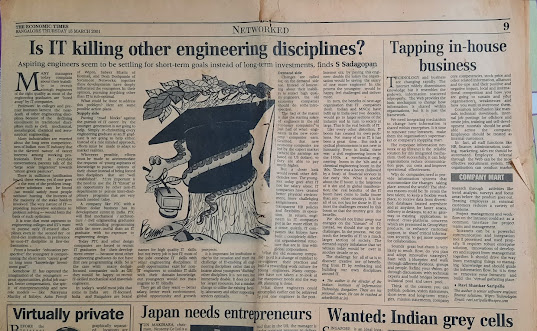
My article published in the Economic Times celebrates 23 years! But... do the assertions made then align with today's reality? Let's reflect on what was written then and compare it to the present.

Dear Friends and Students,

If possible, read the above article which was published on March 15th, 2001 by the Economic Times! I was only a 3-year-experienced Senior Software Engineer, working for Finance Solutions at Wipro Technologies. It was a proud moment on that day when I saw my article published next to Prof. S Sadagopan Sir, Founding Director of IIITB from 1999 to 2021, and he taught for 25+ years at IIT Kanpur, IIM Bangalore, and IIT Madras.

While searching for some stuff today, accidentally I found this paper! Curiously, today I read again both articles—Prof. Sadagopan Sir’s and mine. How far they are true in today’s context!! Interesting, always, right?

My topic was, “Tapping In-House Business,” and Prof. Sadagopan Sir’s was “Is IT Killing other Engineering Disciplines”! By this time, you would have understood what would have been the content of both and their reflections to date. Today it is May 12th, 2024! Yes, the topic “Is IT Killing other Engineering Disciplines” is still valid, but forms are different. I will not go beyond on this topic in this story, rather I would talk more about what I wrote and where we are today!

Friends, though 2001 was a meltdown or dotcom burst year, still in 2001, the majority of Americans didn’t have the Internet. Most people got online using dial-up connections. Only 7% of Internet users worldwide had broadband. Most things purchased online were paid for by money order. On the Internet, print publications were generally navigated using blue hyperlinks. Font-sizes were rarely bigger than what you'd see in an actual paper. There were no videos. Ads were small, boxy, and static and generally looked like they were an afterthought and designed by a gold salesman (vice.com).

In India, if I remember right, the internet service, known as the Gateway Internet Access Service (GIAS), provided a speed of 9.6 kbit/s speed, was priced at ₹5,200 for 250 hours for individuals, ₹16,200 for institutional dial-up SLIP/PPP accounts, and higher for leased line services. Maybe it might have increased to 50+kbit/s!!

During that time, I wrote this article, saying, “Intranet is going to be the future tool for an IT Company’s sustenance”! Employees are internal customers. Intranet is going to be the Company Mart, essential to engage Employees in the Knowledge Industry. They are powerful communication tools. Functions like HR, Finance, Marketing, Admin, Sales, etc., should be totally automated and operated through intranets. Employee referrals, Project Management, Knowledge Management Workflows should be automated in these intranet portals.

You know what, many wrote back to me, “a fancy model”! More maturity is needed to write such stuff! Today after 23 years, what happened to this? I don’t need to justify again! Do you agree?

Now let me write further! I may or may not live that longer for another 23 years, but no human being would be involved in mundane/routine tasks - AI would drive all these functions. AI took 17 years for speech recognition, 14 years for handwriting recognition, 6 years for image recognition, 2 years for reading comprehension. But after 23 years, with this faster pace of learning, AI would handle all tasks which are done by current Engineering/Non-Engineering graduates.

Do you agree? If so, up for an upgrade, else it becomes an uphill task to survive!

Ravi Saripalle


Friday, 26 April 2024

Integrating Minds: Intellectual Property, Design Thinking, and Education for Sustainable Solutions; Read this fascinating story!

Dear Faculty Friends and Students,

Today, on the occasion of World Intellectual Property Day, I had the opportunity to speak at a 2-Day National Workshop on the crucial topic of how Intellectual Property and Future Research are tied up with Sustainable Development Goals (SDGs). The 17 UN-listed Goals and 169 Targets should not be violated by a single IP. If so, we risk opening the door to disaster! Hence, this story gains even more significance.

Let me explain in detail. You are all aware of the fascinating story of the Four Pests Campaign, an initiative launched by China in the late 1950s.

Here's a breakdown of what happened:

The Goal: Sparrows were targeted because they ate grain, including paddy rice. Estimates suggested they consumed around 6.5 kilograms of paddy per year. This can feed more than 60 thousand people happily.

The Unintended Consequences: While sparrows do eat grain, they also prey on insects that damage crops. Eradicating the sparrows (which killed more than 30 lakhs sparrows) led to a surge in these insect populations, causing even greater grain loss (which led to 4.5 crore people dying of hunger).

The Ecological Disaster: The Four Pests Campaign (Rats, Flies, Mosquitoes, Sparrows) resulted in a significant decline in sparrow populations and a rise in insect pests. This had a negative impact on agriculture and the ecosystem.

So, while the initial goal of the campaign was to improve food security, it backfired and led to ecological damage.

Food Security is only the tip of the iceberg! If we don’t properly inspire our students using Design Thinking in conjunction with the Sustainable Development Goals Philosophy, if students choose the wrong set of career/research goals and ideology, all 17 Sustainable Development Goals and 169 targets will be affected.

The unwanted competition for Ranks, the declining ethics in human beings, lack of trust and commitment, ambitious targets and package goals, and fancy Lifestyle goals would affect this deep thinking.

Can we rise above like an Eagle flying beyond the cloud when the storm comes?

 Design Thinking with SDGs would give that strength to the individual to fly beyond the AI storm. Do you agree?

So, what is my appeal to you today? A Special Campaign/Education is needed in the education system, especially for 8th to UG, focusing on Design Thinking (Human-Centered Approach to a particular problem) for SDGs. This combo should drive research goals for faculty and industry, projects for students, ethical teachings for school children, and so on.

Stay Tuned. I will be talking more on this topic in the future. Wishing all responsible education leaders respond to this world cause.

Dr. Ravi Saripalle

Sunday, 14 April 2024

Empowering Bankers: Design Thinking for Success - Exclusive Session by Ravi Saripalle at Prism Institute, Vizianagaram, April 13, 2024

Dear Friends and Students

Yesterday I was invited as a Guest Speaker by Prism Institute, Vizianagaram as part of its 50th Year Celebrations. This institute has been producing Bankers and officers for various Competitive Exams for the last 50 years by its founder Prasad Sir, a well-known Banker from Syndicate Bank! Surprisingly, a few guests who visited yesterday were retired as General Managers of various Banks that were produced by this Institute during 1974-80.

I had the privilege to address this group of officers who recently got selected for various Banks and Aspirants.

My topic was a critical need for Design Thinking to survive in a Banking Career.

Thanks to the 5G internet usage, deeper smartphone penetration, expansion of digital payments, frictionless data-led digital lending, risk-mitigated secure data protection, climate-conscious sustainable goals, and collaboration between banks and FinTechs, Banking career is a different position altogether. The volume of industrial+retail+services credit increased from 6 trillion Rs in 2009 to 41 trillion Rs in 2023 by all banks put together.

Banks started using tech interventions like

- Gen AI- Avatar-driven Virtual Assistants/chatbots,

- Gen AI + Predictive Analytics for improving risk assessment, KYC, fortifying fraud detection and credit scoring, Recognising customer behavior trends, credit decisions with automated underwriting

- Martech-AI in marketing, Bhashini AI for multilanguage support,

- IoT sensors data for accurate Agritech, industrial sensors

- Metaverse- Immersive digital experience, Virtual Branches

- Blockchain- Security and Transparency in every transaction so that no scope for any bank fraud in future

- Central bank digital currencies (CBDCs) are a form of digital currency issued by a country's central bank. They are similar to cryptocurrencies, except that their value is fixed by the central bank

- Frictionless credit framework- a standardized API and prioritizing swifter disbursement and scalability

- API-driven data sharing

- Open Network for Digital Commerce- ONDC will lower entry barriers for commerce participation

- Indian Financial Technology & Allied Services- Made transactions more secure

- BaaS Model- Tech-savvy neo-banking FinTechs operating on Banking as a Service (BaaS) platform with regular banks, helping Core banking services possible for traditional banks

- Data monetization- data is money

In this hour of Technology intervention, you tell me what skill a Banker needs?

My Answer is Design Thinking. Design Mindset! An empathy or Human Centred Experiential Innovations.

Do You Agree?

Ravi Saripalle